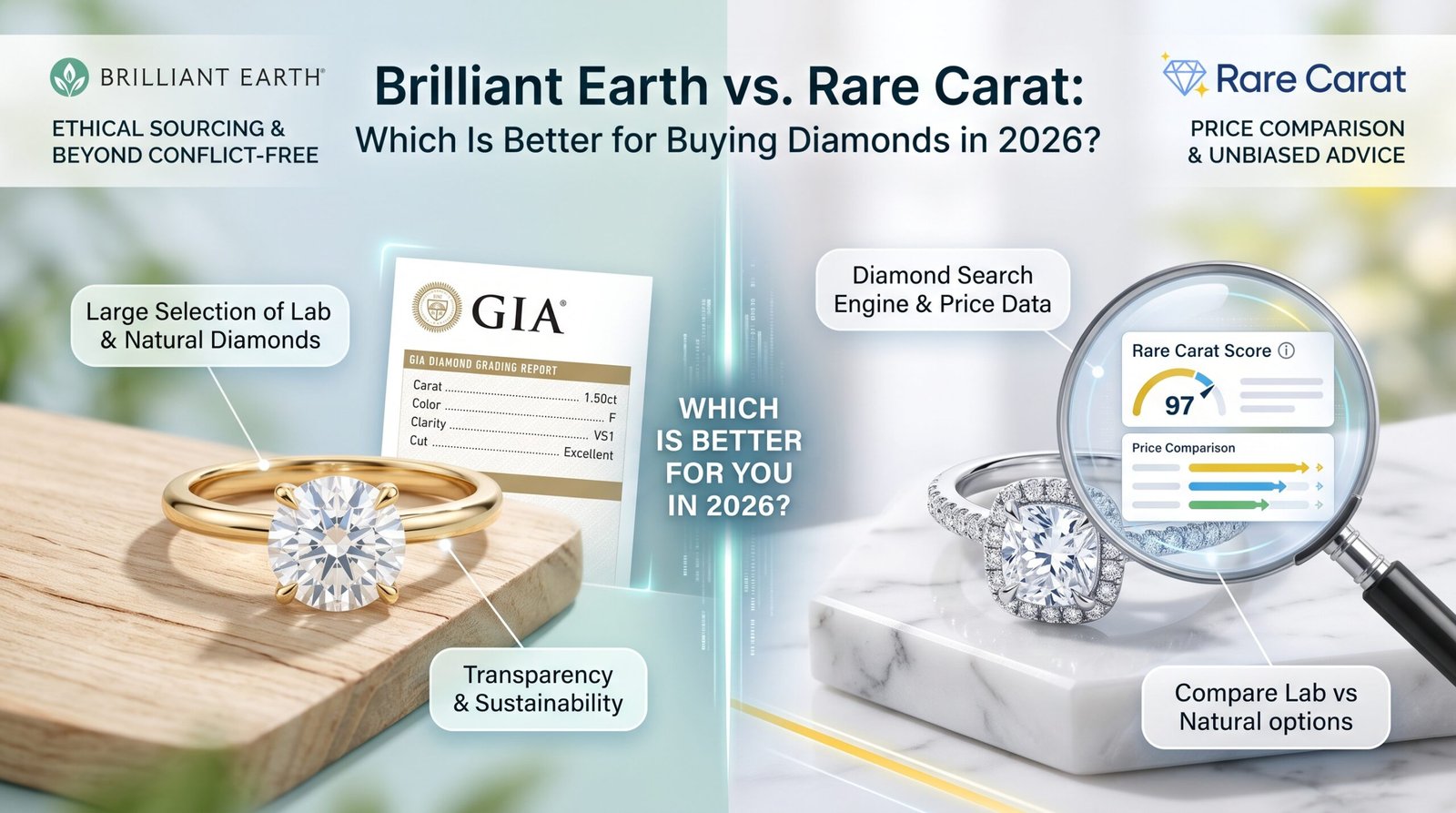
Buying a diamond online still feels like a leap of faith for most people. You can’t hold the stone, you can’t ask a jeweler to tilt it under the light, and you’re trusting a website with one of the biggest purchases of your life. Two names dominate that conversation right now: Brilliant Earth and Rare Carat. Both promise transparency, both promise value, and both have loyal fans — but they’re built on genuinely different business models, and that difference matters more than most reviews let on.
We dug into how each company sources diamonds, certifies them, prices them, ships them, and handles problems when things go wrong. Here’s the honest Brilliant Earth vs Rare Carat breakdown, built for 2026 shoppers who want a straight answer instead of a sales pitch.
Brilliant Earth vs Rare Carat: Quick Comparison Table
| Feature | Brilliant Earth | Rare Carat |
|---|---|---|
| Business model | Retailer, owns and curates its own inventory | Managed marketplace, aggregates vetted wholesalers |
| Diamond types | Natural & lab grown diamonds | Natural & lab grown diamonds |
| Certification | GIA, IGI | GIA, IGI, GCAL |
| Price positioning | Mid-to-premium | Budget to mid-range, often lower |
| Returns | Free 30-day returns, both ways | Free 30-day returns |
| Warranty | Free lifetime manufacturing warranty | Money-back guarantee, in-house inspection |
| Customization | Extensive Create-Your-Own ring builder | Custom ring builder with thousands of settings |
| Sourcing focus | Responsible/ethical sourcing is core brand identity | Price transparency and AI-based quality scoring |
| Best for | Buyers who prioritize sustainability and a boutique feel | Buyers who prioritize price and comparison shopping |
What Is Brilliant Earth?
Brilliant Earth built its entire brand around ethically sourced diamonds and responsible jewelry. It’s a direct retailer — meaning it owns its inventory, controls its supply chain, and stakes its reputation on sourcing claims rather than aggregating from outside vendors. The company markets itself as a leader in traceable, conflict-free sourcing, and it backs that positioning with detailed sourcing pages, a jewelry recycling program, and blockchain-tracked stones for certain collections.
Where Brilliant Earth really shines is the shopping experience: showroom-style photography, a well-organized Create-Your-Own engagement ring tool, and physical showrooms in several U.S. cities for buyers who want to see pieces in person before committing online.
What Is Rare Carat?
Rare Carat started in 2016 as a diamond search engine — often nicknamed the “Kayak of diamonds” — built to help shoppers compare prices across retailers using AI-driven quality scoring. In 2021, the company shifted to a managed marketplace model. It now acts as the merchant of record on every sale, meaning Rare Carat handles the payment, customer service, and guarantee, even though the physical diamond is often shipped from one of its vetted wholesale partners.
Every natural diamond sold comes with GIA or IGI certification, and lab grown diamonds are certified by IGI, GIA, or GCAL. Rare Carat’s team of in-house gemologists inspects diamonds before they reach the customer, and its AI-powered “Deal Score” tool flags diamonds with weak cut performance even when the certificate itself looks good on paper — a genuinely useful feature for shoppers who don’t know what to look for.
Pricing Comparison
This is where the two companies diverge the most. Rare Carat’s marketplace model removes a layer of retail markup by connecting buyers directly to wholesalers competing on price in real time — the company has built its reputation on undercutting traditional retailers. Brilliant Earth, as a direct retailer with its own overhead, showrooms, and sourcing standards, typically sits at a higher price point for comparable diamond quality.
That doesn’t mean Rare Carat is automatically the smarter buy for everyone. Diamond prices overall have been trending downward in 2026, with lab grown diamonds now costing roughly 60–80% less than natural stones of similar specifications, so the size of the gap between retailers can shrink or widen depending on which type of diamond you’re comparing. If price-per-carat is your top priority, run the same specs through both sites before deciding — the savings on Rare Carat can be meaningful, especially on larger natural stones.
Diamond Quality & Certification Comparison
Diamond certification is non-negotiable, and both companies get this right. Brilliant Earth diamonds are certified by GIA or IGI. Rare Carat diamonds carry GIA or IGI certification for natural stones, with GCAL added as an option for lab grown diamonds.
| Certification Factor | Brilliant Earth | Rare Carat |
|---|---|---|
| Natural diamond certifiers | GIA, IGI | GIA, IGI |
| Lab diamond certifiers | GIA, IGI | GIA, IGI, GCAL |
| In-house verification | Quality control on all pieces | Every diamond inspected in-house before shipment |
| Cut-quality tooling | Diamond imagery, videos | AI “Deal Score” cut analysis |
The American Gem Society (AGS) and GIA remain the two most respected independent grading labs in the industry, and the Federal Trade Commission (FTC) requires any diamond seller to accurately disclose whether a stone is natural or lab grown — both companies comply with this standard.
Shipping, Returns & Warranty Comparison
| Policy | Brilliant Earth | Rare Carat |
|---|---|---|
| Shipping | Free, fully insured, FedEx | Free, insured, overnight via FedEx or UPS |
| Returns | Free 30-day returns/exchanges | Free 30-day returns, 100% money-back guarantee |
| Resizing | Free within 60 days (or 1 year within range) | 1 year of complimentary resizing |
| Warranty | Free lifetime manufacturing warranty | Money-back guarantee plus in-house inspection |
| International shipping | Free FedEx International Priority | Domestic-focused, U.S. shipping |
Both companies require a signature on delivery and insure packages in transit, which is standard — and important — for any online diamond purchase.
Customer Service Comparison
Brilliant Earth offers 24/7 live chat and text support, phone support, and in-person appointments at its physical showroom locations — a real advantage if you want a human to walk you through the process face-to-face. Rare Carat leans on in-house gemologists who are explicitly not paid on commission, meaning their diamond recommendations aren’t tied to pushing a more expensive stone. Rare Carat has also built a reputation as a Trustpilot-leading jeweler for responsiveness and follow-through.
“Our gemologists are instructed to give advice as if they were helping a friend or family member.” — Rare Carat, on its no-commission advisory model
Pros & Cons
Brilliant Earth Pros & Cons
Pros
- Strong, well-documented sourcing and sustainability practices
- Physical showrooms for in-person shopping
- Free lifetime manufacturing warranty
- Polished, easy-to-navigate design tools
Cons
- Generally higher prices than marketplace competitors
- Warranty excludes wear-and-tear and gemstone loss
- Fewer real-time price comparison tools
Rare Carat Pros & Cons
Pros
- Competitive, often lower pricing through its marketplace model
- AI-powered cut and price analysis (Deal Score)
- No-commission gemologist advice
- Strong money-back guarantee and 30-day returns
Cons
- Diamond may ship from a third-party partner, so delivery timing can vary
- No physical showroom network
- Newer to the full-retail model (since 2021), with a shorter retail track record than Brilliant Earth
Who Should Buy Brilliant Earth?
Choose Brilliant Earth if sourcing transparency, in-person shopping, and a lifetime warranty matter more to you than shaving dollars off the final price. It’s a strong fit for buyers who want a boutique, guided experience and who feel more confident buying from a company that owns its entire supply chain.
Who Should Buy Rare Carat?
Choose Rare Carat if you want to compare pricing across a wide vetted network before committing, and you’re comfortable with a slightly more hands-off shipping process in exchange for potential savings. It suits data-driven shoppers who like using AI tools to double-check a diamond’s cut quality against its certificate.
Real Buying Examples
Example 1: A couple shopping for a 1.5-carat round natural diamond found that comparable GIA-certified stones were listed several hundred dollars cheaper on Rare Carat than a similar spec on Brilliant Earth — but the Brilliant Earth stone came from in-house inventory with a lifetime warranty already attached.
Example 2: A buyer prioritizing lab grown diamonds for budget reasons found strong options on both platforms, since lab grown pricing has compressed sharply in 2026 — the deciding factor ended up being Brilliant Earth’s in-person showroom versus Rare Carat’s AI cut-analysis tool.
Diamond Buying Guide — Expert Tips & Common Mistakes
Expert Tips
- Always confirm the diamond has an independent certificate from GIA, IGI, AGS, or GCAL before buying — never rely on a retailer’s internal grading alone.
- Prioritize cut quality over carat weight; a well-cut smaller diamond often looks more brilliant than a larger, poorly cut one.
- Compare price-per-carat across at least two retailers before finalizing a purchase.
Common Buying Mistakes
- Chasing carat weight and ignoring cut grade
- Skipping the return policy fine print (deadlines often start at ship-readiness, not delivery)
- Not asking whether a diamond is natural or lab grown diamonds — the FTC requires disclosure, but always confirm directly
Interesting Facts & Statistics
- Lab grown diamonds now cost roughly 60–80% less than natural diamonds of comparable specifications.
- Diamond prices overall have trended downward through early-to-mid 2026, partly driven by growing lab-grown supply.
- A 2-carat diamond can cost three to four times more than a 1-carat diamond of the same quality, due to rarity, not simple weight doubling.
Expert Recommendation
If your priority is verified ethical sourcing, a physical showroom option, and a no-questions lifetime warranty, Brilliant Earth is the safer, more curated choice. If your priority is finding the lowest possible price on a certified stone and you’re comfortable with a marketplace-style fulfillment process, Rare Carat is likely to save you money without sacrificing certification quality. Neither is objectively “better” — the right pick depends on whether you value control over the supply chain or control over the price.
Conclusion
The Brilliant Earth vs Rare Carat debate really comes down to what kind of buyer you are. Brilliant Earth wins on brand trust, sourcing transparency, and a lifetime warranty. Rare Carat wins on price competitiveness and AI-assisted quality scoring. Both offer certified diamonds, solid return policies, and legitimate customer service — so there’s no wrong choice here, just a better fit for your priorities.
FAQs
Is Rare Carat cheaper than Brilliant Earth? Generally, yes — Rare Carat’s marketplace model tends to produce lower prices on comparable certified diamonds, though it’s worth comparing specific stones since pricing varies by carat, cut, and certification.
Is Brilliant Earth worth the extra cost? For buyers who value ethical sourcing claims, a lifetime warranty, and in-person showroom access, many find the added cost worthwhile.
Which has better diamond certification, GIA or IGI? GIA is widely regarded by the industry, including the American Gem Society, as the strictest and most consistent grading lab, though IGI is also a legitimate certifier used by both retailers.
Do both companies sell lab grown diamonds? Yes, both Brilliant Earth and Rare Carat sell certified natural and lab grown diamonds.
Can I return a diamond ring if I change my mind? Both companies offer free 30-day return windows, though the clock generally starts when the order is ready to ship, not when you receive it — check each company’s specific terms.
Call to Action
Still weighing your options? Compare more online diamond retailers in our full diamond shopping guide, browse our engagement ring buying checklist, and subscribe to our newsletter for fresh diamond price drops. Found this comparison helpful? Share it with a friend who’s ring shopping, and drop a comment below with your own Brilliant Earth or Rare Carat experience.
8. References
- Brilliant Earth — brilliantearth.com (returns, warranty, and shipping policy pages)
- Rare Carat — rarecarat.com (about, education, and seller pages)
- GIA (Gemological Institute of America)
- IGI (International Gemological Institute)
- American Gem Society (AGS)
- Federal Trade Commission (FTC) — jewelry and diamond disclosure guidelines